
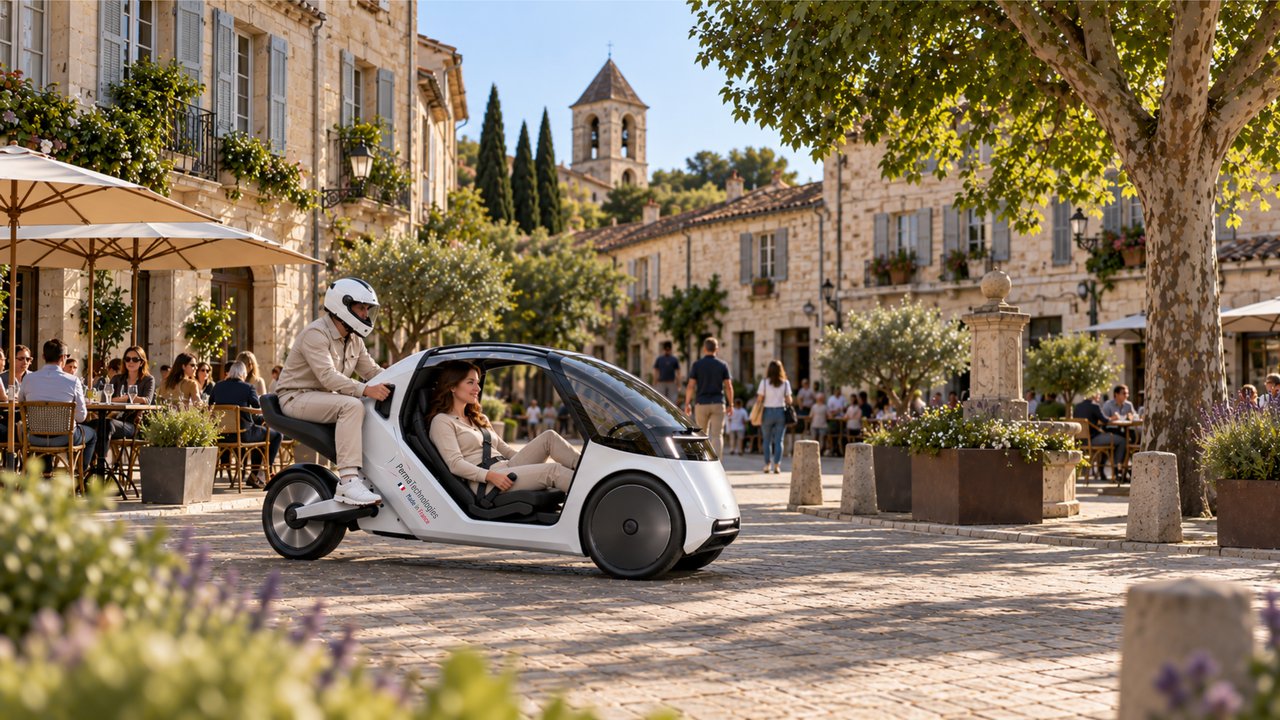
Artist’s impression © Félix Sanchez 2026
A new middle ground between bike and car
Based in La Rochelle, PermaTechnologies is a light vehicle project for everyday journeys on the outskirts of cities: a faired electric recumbent bike with suspension, designed for speeds of up to 45 km/h.
In peri-urban areas, many everyday journeys are too long to make by bicycle
Transport is the largest source of greenhouse gas emissions in France, and cars account for half of transport emissions. Electrifying the car fleet only partly meets the challenge of the mobility transition, slightly improving efficiency without significantly reducing waste: 9 out of 10 drivers travel to work alone in a tonne and a half of steel, and average occupancy is just 1.43 people per vehicle.
Beyond overconsumption and emissions, electric cars do not address crowded public space, excessively sedentary lifestyles or fair access to transport.
Even with electric assistance, the bicycle remains relevant for distances of up to about ten kilometres (20 km there and back): at 25 km/h, that is how far you can travel each way while keeping travel time under an hour a day (Zahavi’s conjecture). In practice, lack of comfort and road danger bring this distance down to 5 km, beyond which cycling to work becomes marginal.
These limits make it unsuited to peri-urban needs, where journeys are longer. With no alternative, people living in peri-urban areas, who are the most car-dependent, are being left behind in the mobility transition.
- 43%
- of the population lives in peri-urban areas
- 89%
- of workers in these areas drive to work
- 13 km
- median commuting distance for peri-urban workers, compared with 6 km in urban centres
PermaTechnologies aims to meet this need with an environmentally friendly, affordable and practical solution, designed to be manufactured in France: a new way into sustainable mobility, without forcing an immediate change in habits or existing infrastructure.
Sources (in French)
- SDES, Chiffres clés des transports, 2026 edition
- SDES, Se déplacer en voiture : seul, à plusieurs ou en covoiturage ?, 2022 (2019 data)
- Zahavi’s conjecture (travel time budget)
- Insee, La France et ses territoires, 2021: functional urban areas
- Insee, La France et ses territoires, 2021, dossier 2, pp. 38–39 (2017 data)
A faired recumbent bike with suspension

- What?
-
An intermediate vehicle, also known as a VELI, for véhicule léger intermédiaire (light intermediate vehicle), or USV, for Ultra-Small Vehicle.
To be comfortable, safe and efficient, the vehicle will be electric and recumbent, with a fully enclosed fairing. Retaining pedal power, it belongs to the family of so-called ‘active’ intermediate vehicles, an augmented bicycle that bridges the gap with the car.
- 2 people, driver included, to meet the vast majority of needs: average car occupancy is 1.43 people;
- 45 km/h top speed (category L2e);
- 45 to 200 km range, depending on the number of batteries on board (modular system).
- Why?
-
Because the French National Low-Carbon Strategy sets a clear course: virtually carbon-free transport by 2050. The car market, meanwhile, is moving towards bigger rather than leaner vehicles, with SUVs reaching 53% of new car sales in 2025.
Because mobility is about more than carbon. The specifications also cover:
- health, by staying physically active every day;
- road safety, with a light vehicle, moderate speed and greater visibility;
- frugality, in raw materials as well as public space;
- fair access to mobility, with lower purchase and running costs.
- When?
-
For local journeys of under 80 km, which make up most needs: on average, people in France make only six journeys of over 80 km a year. The main intended use is the commute, which is regular and predictable, while allowing for the modularity needed for multi-stop trips (shopping, school), notably through compatibility with existing bike trailers and with bicycle and motorcycle luggage systems.
- Where?
-
In peri-urban areas. With a top speed of 45 km/h, the vehicle covers around twenty kilometres in 30 minutes, well beyond the 13 km of the median commute. Its suspension allows it to travel comfortably on secondary roads, away from major routes, to limit conflicts with cars.
- Who?
-
First, working people for whom a car is oversized: multi-car households that can replace their second car without major changes to their habits. Also people who live alone, for whom a five-seat vehicle is oversized. Together, these two cases account for almost half of the French car fleet (Aurélien Bigo, Transports urbains, no. 141, 2022, p. 23).
As it is aiming for type approval in category L2e (three-wheeled moped), the vehicle could be driven with a simple AM licence. It would therefore offer a mobility option for people who do not hold a car licence (category B).
- How?
-
The fairing contributes both to the driver’s comfort and to the vehicle’s energy efficiency. It protects against bad weather and, combined with a recumbent driving position, reduces aerodynamic drag. This optimisation limits the power needed at a given speed and can help increase top speed or range, depending on conditions of use.
Combined with a low mass, which helps limit the rolling resistance of the tyres, this design aims to optimise energy consumption and maximise the vehicle’s range.
The velomobile, reworked for everyday use
The velomobile, a faired recumbent bike, is the most efficient human-powered vehicle. But its design, geared towards sporting performance, holds back its adoption for everyday use.
Comparison between the current velomobile and the PermaTechnologies vehicle Criterion Current velomobile PermaTechnologies Safety Very low, hard to see in traffic Raised to be seen by other road users Comfort Rigid shell, short-travel suspension: vibration and noise on poor road surfaces Interconnected full suspension for comfortable travel on secondary roadsTilting mechanism: the vehicle leans into bends to maximise comfort and stability despite its compact size Practicality Large turning circle, due to the limited clearance around the front wheels and the risk of tipping overWith a few rare exceptions, no reverse gear for manoeuvringWithout type approval, electric assistance limited to 25 km/h Rear-wheel steering for a minimal turning circleReverse built into the electric driveType-approved for 45 km/hBuilt-in pedal generator for a constant pedalling cadence and torque, tailored to the user, and minimal maintenance
The tilting suspension
The technical heart of the project, it tilts the vehicle into bends and compensates for road camber. This allows it to remain highly stable with a narrow track, taking up less public space.
Only feasible on a light vehicle, this technology is a lever for technical innovation that is out of reach for cars. A suspension prototype has been built, and a patent application is being considered.
Pedalling is first and foremost for your health
Pedalling is retained: it keeps you fit, extends the range and, through physical effort, makes tangible the notion of energy that lies at the heart of the transition.
Among people over 40, meeting the WHO recommendation of 150 minutes of moderate activity a week is associated with 3.4 extra years of life expectancy, and up to 4.5 years beyond 450 minutes (Moore et al., PLoS Medicine, 2012).
Design and manufacturing
A robust look to reassure people about quality and safety, and to meet the expectations of drivers used to a market dominated by SUVs.
The project favours components made by French start-ups.
Energy use
Around 1.5 kWh per 100 km: ten times less than an electric car and forty times less than a combustion-engine car. See the comparison
From SUV to USV
Ever bulkier vehicles and falling occupancy: cars are becoming increasingly mismatched to how people actually use them. The project takes the opposite course to this ‘SUVification’ of the car market: the USV, a vehicle sized as closely as possible to actual needs.

- +56%
- increase in the average mass of cars since 1960
- 1.43
- occupants on average in a five-seat car
Aurélien Bigo, Voitures. Fake or not ?, 2023, p. 36; SDES, Enquête mobilité des personnes 2019; manufacturers’ dimensions and masses.
PermaTechnologies simulation (2026). Reference calorific value: 9 kWh per litre.
Electrification improves efficiency: it is necessary progress, but it is not enough. Tackling oversizing is the real lever for more frugal mobility.
Over 95% energy saved compared with a combustion-engine car,
for less than 20% extra travel time!
Cheaper to buy and cheaper to run
Estimates based on in-house simulations using data measured on real journeys.
- €10,000
- target purchase price, compared with an average of €36,108 for a new car in 2025
- €0.37
- of electricity per 100 km, compared with €10.38 of petrol for a car
- 4 years
- to pay back the purchase, on the same monthly budget as a car
Monthly budget: a case study of the average French driver
| Item | Car | Perma |
|---|---|---|
| Purchase | €166 | €46 |
| Energy | €101 | €4 |
| Insurance | €58 | €58 |
| Residential parking | €47 | €47 |
| Maintenance | €48 | €48 |
| Tolls | €16 | €0 |
| Other costs | €4 | €4 |
| Total per month | €440 | €207 |
Amounts rounded to the nearest euro.
€52
saved per extra hour of travel
- €233
- saved every month, or over €2,800 a year
- 4.5 h
- of extra travel time per month on average
So the fastest journey is not necessarily the most cost-effective. A dozen extra minutes a day can save you more than €200 a month.
Assumptions: simulated USV consumption equivalent to 0.16 L of SP95 unleaded petrol per 100 km, i.e. 1.44 kWh (9 kWh per litre); electricity at €0.255/kWh (2025 average household price, SDES); car at 6 L per 100 km and SP95-E10 at €1.73/L (2025 average price, SDES); average car budget of €440 a month (Roole Data, 2026 edition, 2025 data) and average new car price of €36,108 in 2025 (Roole Data); monthly purchase cost proportional to the purchase price; no tolls, as the vehicle is not allowed on toll roads; insurance, parking, maintenance and other costs unchanged; 5 h 10 min spent driving per week (Autotrader survey) and travel time about 20% longer, measured on a peri-urban commute.
From craft frame building to small-batch production
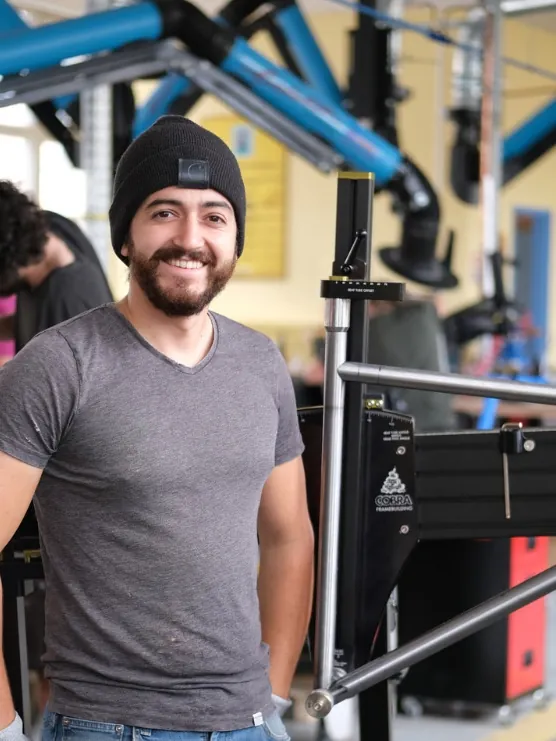
Passionate about low-impact transport, I took part in the 2014 EducEco race, then turned to building sailing boats.
After a spell living in Amsterdam, I adopted the bicycle as my main means of transport. Since returning to France, I have been working to combine my interest in cycling with my design and manufacturing skills.
Once I became a frame builder, I saw the limits of the craft model, which is confined to the high-end market. I went back to studying at the IUT de Poitiers to semi-industrialise my method and work towards affordable ‘made in France’ products. My goal now is to produce, in France and in small batches, an intermediate vehicle that takes the bicycle beyond its current boundaries.
Félix Sanchez
- Design
- Training in technical drawing, to BTS level.
DUT and BUT in Mechanical and Production Engineering (IUT de Poitiers) - Manufacturing
- Cycle technician certificate (CQP), professional qualification as a metalworker, frame-builder training at Cycles Victoire with AFPA (2022)
- Experience
- Time spent in the workshops of MILC in the Hautes-Pyrénées, Cycles Victoire in Clermont-Ferrand and CYFAC International in Tours

Where the project stands
From studies to the first prototypes, then on to a type-approved vehicle by 2030.
-
Done
Market study and specifications
Historical, sociological and economic analysis of mobility, and defect analysis of the velomobile and the car.
-
Done
Suspension prototype and measuring tool
A tilting suspension test bench, built in 2025, and a measuring tool, both made in-house.
-
Done
Joining PEPITE in La Rochelle
The project is now supported by PEPITE ECA, in La Rochelle.
-
In progress
Vehicle design
The drivetrain and braking systems have been sized and the components selected. The first vehicle layout is finalised; the tilting suspension is being designed, with its kinematics currently being validated.
-
2027
Rolling chassis prototype
A first rolling vehicle, to test the chassis in real-world conditions. Patent application under consideration, integration into the La Rochelle business community and search for partners.
-
2028
Prototype with a full fairing
Integration of the fairing and continued search for partners.
-
2030 target
A type-approved vehicle

Prototyping at lower cost
Around €30,000 of equipment dedicated to the project (metalwork, TIG welding, machining, 3D printing, etc.) for in-house design and assembly, as well as most of the manufacturing.
Large parts and industrial processes are produced in collaboration with local partners, such as the IUT de Poitiers for the first prototypes. This prototyping method brings costs down to around 5% of what a contractor would have charged for the design and manufacturing.
With the support of




Let’s scale up and build the alternative
In 2027, the rolling chassis prototype will serve as the basis for bringing together a team ready to take the USV all the way to market. The search for business partners starts today: the project needs new skills, partners and funding.
-
Become a business partner
You have experience in industrialisation or business development and would like to commit to the project for the long term.
Join as a business partner -
Fund the development
The rolling chassis, the fairing and the patent are the next steps to fund. Let’s discuss the possible forms of support.
Talk about funding -
Develop components together
The project aims to favour components designed in France, such as batteries or the pedal generator, rather than imported products.
Propose a partnership -
Support the project
Business support organisations, technology parks, laboratories: your resources and expertise can speed up development.
Offer support